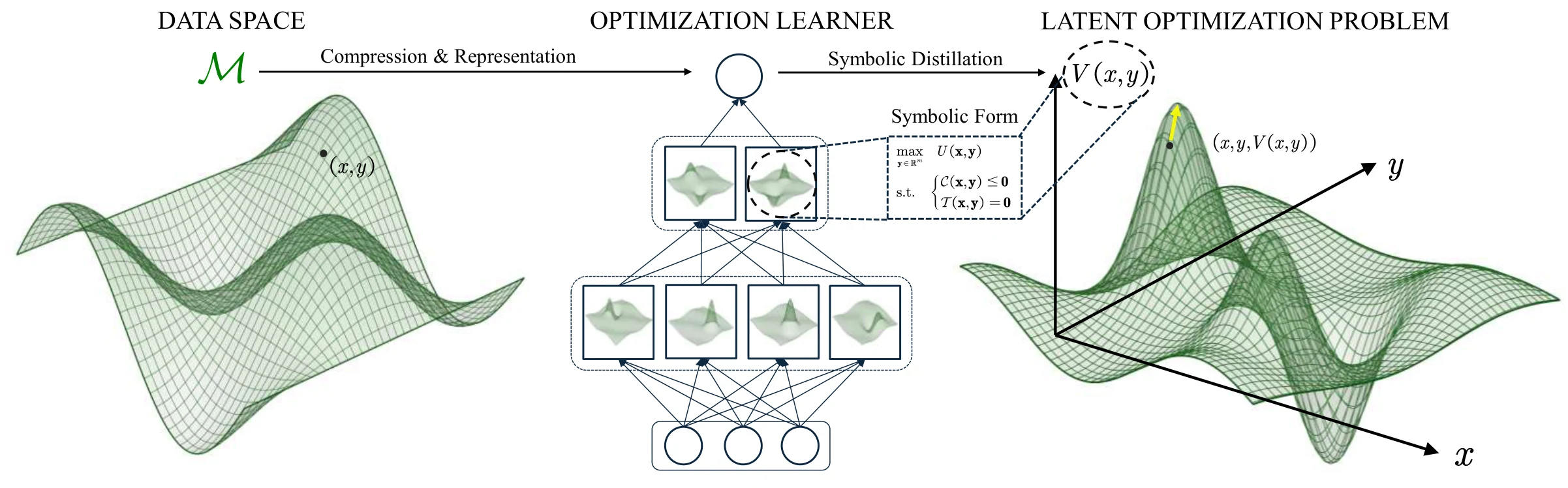
Discover the optimization law behind the observations. OptScientist first learns to represent data as an optimization problem, then extracts a compact symbolic law and places it within an iterative scientific-discovery process.
Figure 1.From observations to optimization laws. A learned optimization representation bridges a complex data space and a compact symbolic law.
Abstract
Many scientific phenomena are best understood as outcomes of underlying optimization problems, yet automated scientific discovery has largely focused on recovering equations that describe observed input–output patterns. We introduce OptScientist, a novel automated framework for discovering compact symbolic optimization laws directly from data. OptScientist comprises (i) a model that infers symbolic optimization problems by first learning to represent data as an optimization problem and then extracting its symbolic form, and (ii) an LLM agentic system embedding the model in a discovery process that integrates theoretical priors from scientific literature, discovers candidate laws, abstracts their underlying mechanisms, and suggests new data to collect. We first evaluate OptScientist on OptFeynman, a novel benchmark of 99 physics-derived optimization problems, where OptScientist recovers ground-truth laws for over 80% of the problems and remains robust to noisy contextual information, while substantially outperforming machine-learning, symbolic, and LLM-based model-discovery baselines. On human risky choice and central-bank monetary policy, OptScientist discovers compact symbolic optimization laws that achieve held-out predictive performance competitive with leading baselines, while using few parameters and substantially fewer tokens than LLM baselines. Overall, OptScientist extends automated scientific discovery to uncovering optimization laws that generate observed phenomena, enabling automated theory building across the physical, biological, behavioral, and social sciences.
Can optimization laws be discovered from data?
Across science, important explanations take the form of optimization problems: energy or free-energy minimization in statistical physics, fitness-related optimality models in biology, rational and resource-rational accounts of behavior and cognition, and intertemporal optimization in macroeconomics.
Building these theories means identifying objectives and constraints that explain what we observe. Traditionally, scientists formulate those mathematical structures first and then test them against data. As a result, discovering optimization-based explanations depends heavily on domain experts manually specifying a theory.
The problem becomes harder with real observations: they may be noisy, high-dimensional, and shaped by complex interactions. Hand-crafted interpretable models can miss complex patterns, while flexible machine-learning models can predict without revealing the underlying law.
Bottleneck 01
Manual theory construction
Objectives and constraints are usually supplied by scientific experts, rather than discovered from observations.
Bottleneck 02
Structure beyond prediction
Automated discovery largely targets input–output equations; learned optimization representations still require interpretation to become symbolic scientific laws.
Can optimization laws be discovered automatically from observational data?
OptScientist is designed to make optimization-law discovery itself the object of automated scientific discovery.
From input–output equations to optimization laws
Scientific machine learning has made progress in symbolic law discovery and in combining mathematical structure with flexible models. Yet much of automated discovery still focuses on equations that directly relate measured inputs and outputs. For systems understood through optimization, that may leave the crucial scientific question unanswered: what objective and constraints generate the observed outcome?
In an optimization-based account, observed outcomes are solutions to an underlying optimization problem. The law is the objective and constraint structure, not merely a fitted prediction rule.
The quantity being maximized or minimized in the proposed scientific explanation.
Constraints
Restrictions and consistency conditions relevant to that explanation.
Outcomes
The observed responses generated under the problem's context and latent optimization structure.
The discovery target is an optimization objective together with its relevant constraints—not only the map from inputs to outputs.
Learn the representation. Discover the law.
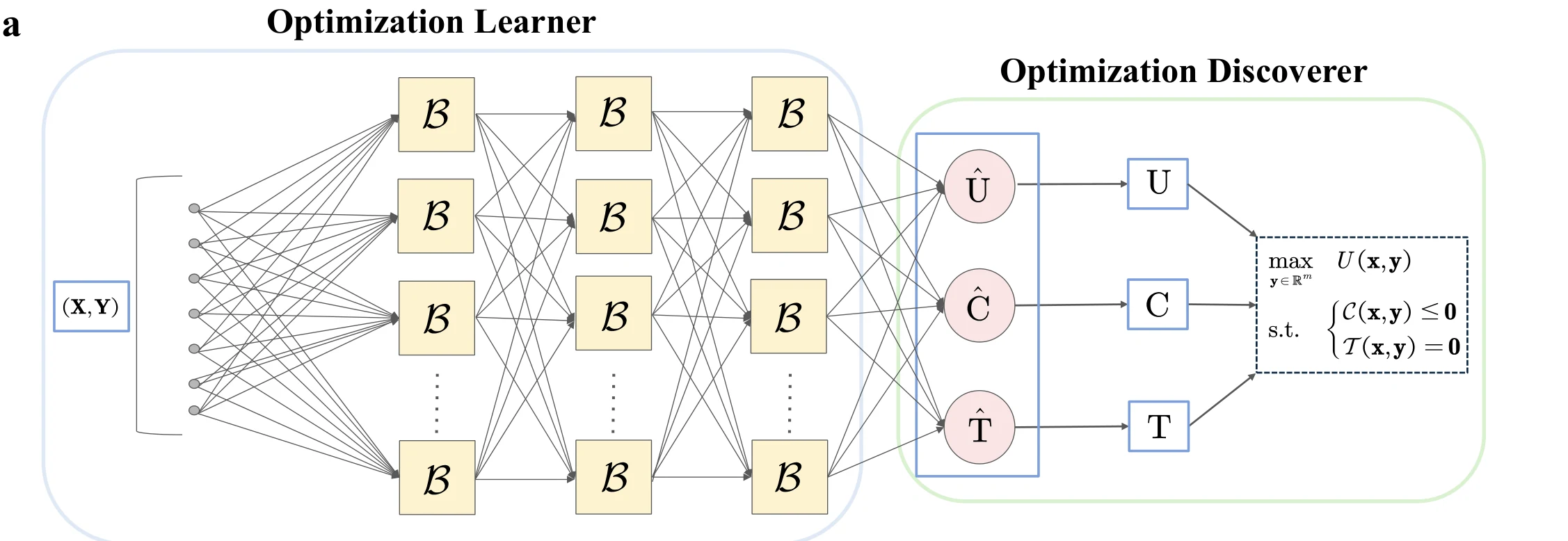
The OptScientist Model tackles a central difficulty: raw scientific observations may not expose a compact symbolic structure. It therefore separates discovery into two linked stages—optimization representation learning and symbolic distillation.
Observational data→OptLearner→Optimization representation→OptDiscover→Symbolic law
1. OptLearner: represent data as an optimization problem
Using a hierarchical optimization network with an optimization representation bottleneck, the model learns an optimization landscape from observations. This allows it to denoise, compress information, and extract interpretable features before symbolic discovery.
Figure 2.A bottleneck for symbolic optimization laws. The hierarchical optimization learner produces objective and constraint representations, which are subsequently distilled into expressions.
2. OptDiscover: extract the compact symbolic form
Once the optimization representation has been learned, OptDiscover distills its learned structure into a compact symbolic optimization problem. The learned representation exposes a structure that can be expressed symbolically, even when raw observations are noisy, redundant, or high-dimensional.
The central distinction: the model does not stop at recovering a black-box prediction or an input–output expression; it seeks a symbolic optimization problem that accounts for observed outcomes.
From symbolic discovery to an iterative scientific process
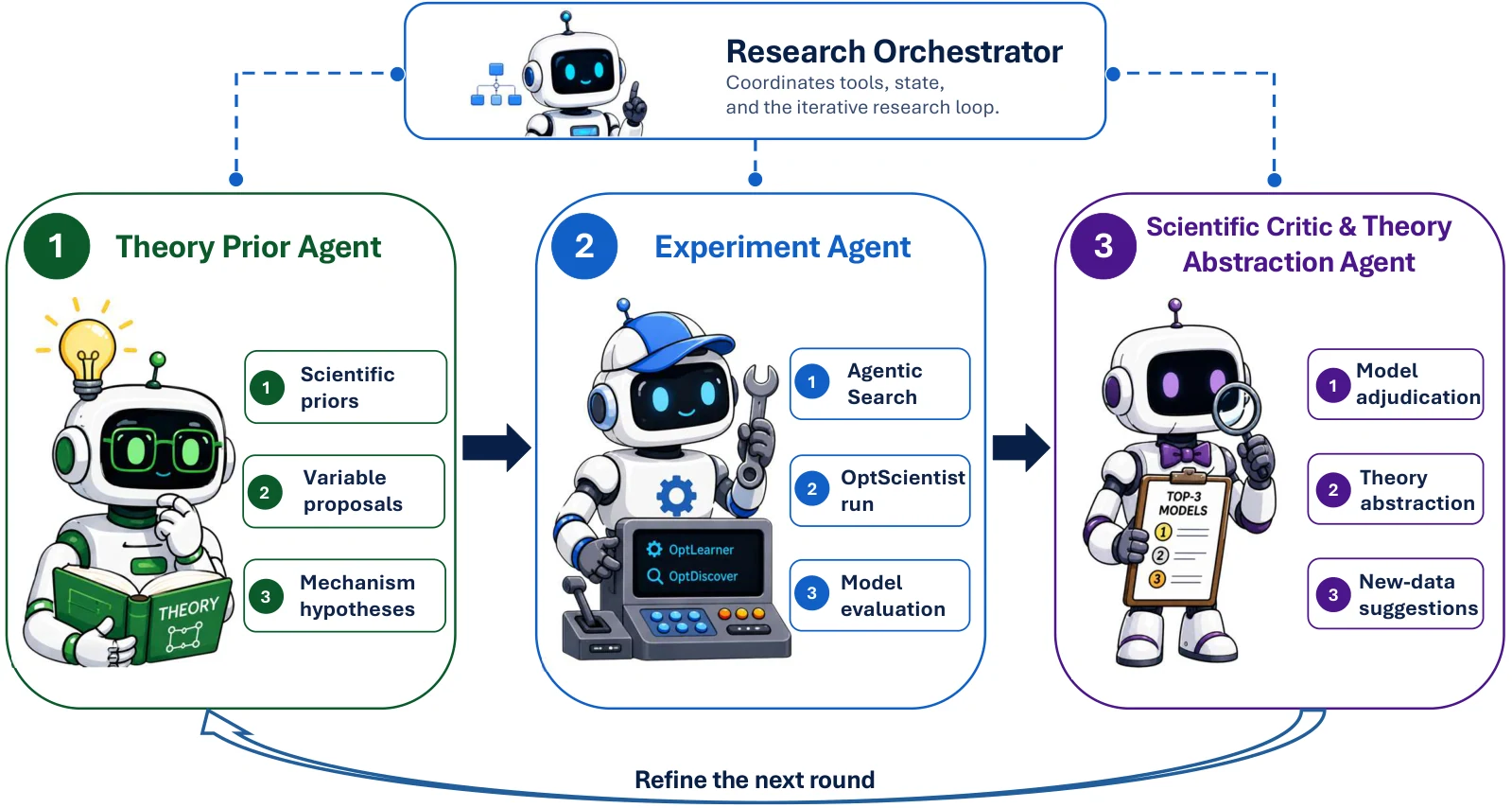
Scientific discovery involves more than model fitting. Researchers use existing theories to choose variables, interpret the resulting laws, distill common mechanisms, and decide what evidence is needed next. OptScientist Agent places the symbolic-discovery model inside this broader research loop.
Figure 3.The OptScientist research loop. A research orchestrator coordinates scientific priors, empirical law discovery, scientific critique, theory abstraction, and the next discovery round.
Theory prior
Propose scientific priors, candidate variables, and mechanism hypotheses based on the research question and existing literature.
Experiment
Use the OptScientist Model to search observational data for compact symbolic optimization laws.
Critique & abstraction
Evaluate candidate laws, select supported structures, abstract general forms and qualitative mechanisms, and propose new variables or data.
Orchestration
Maintain shared research state and coordinate iterative refinement across discovery rounds.
A hybrid scientific-discovery system: a specialized model performs optimization-law discovery; LLM research agents use scientific priors and interpret the resulting evidence to inform the next search.
Empirical evidence
Discovering laws across scientific settings
OptScientist is evaluated on a controlled benchmark with known generating laws and on two real-world scientific-discovery tasks where the underlying optimization laws are unknown.
01 PHYSICAL SYSTEMS · Ground-truth recovery
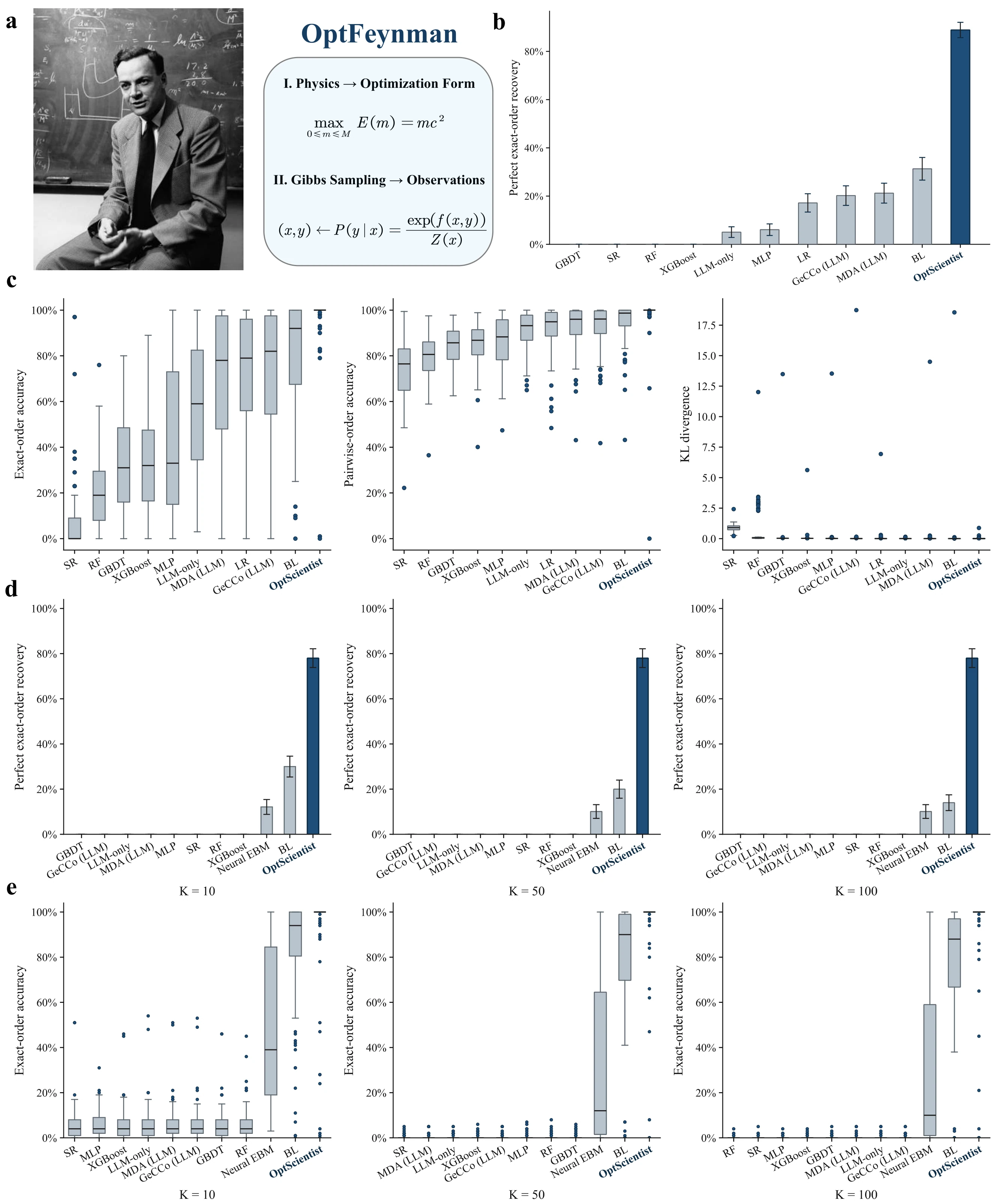
OptFeynman: recovering the generating optimization law
OptFeynman comprises 99 optimization problems derived from analytic physics equations. Each problem generates noisy observations from an induced optimization landscape. On held-out contexts, OptScientist recovers the ground-truth ranking in 88 of 99 discrete tasks and 78 of 99 continuous tasks, substantially outperforming the evaluated machine-learning, symbolic-regression, and LLM-based discovery baselines. Recovery also remains robust to noisy context variables.
Figure 4.OptFeynman: benchmark construction and law recovery. The complete original figure, including the benchmark illustration and all discrete and continuous comparisons. Select to view at full resolution ↗
02 HUMAN BEHAVIOR · Risky choice
Human decisions under risk and ambiguity
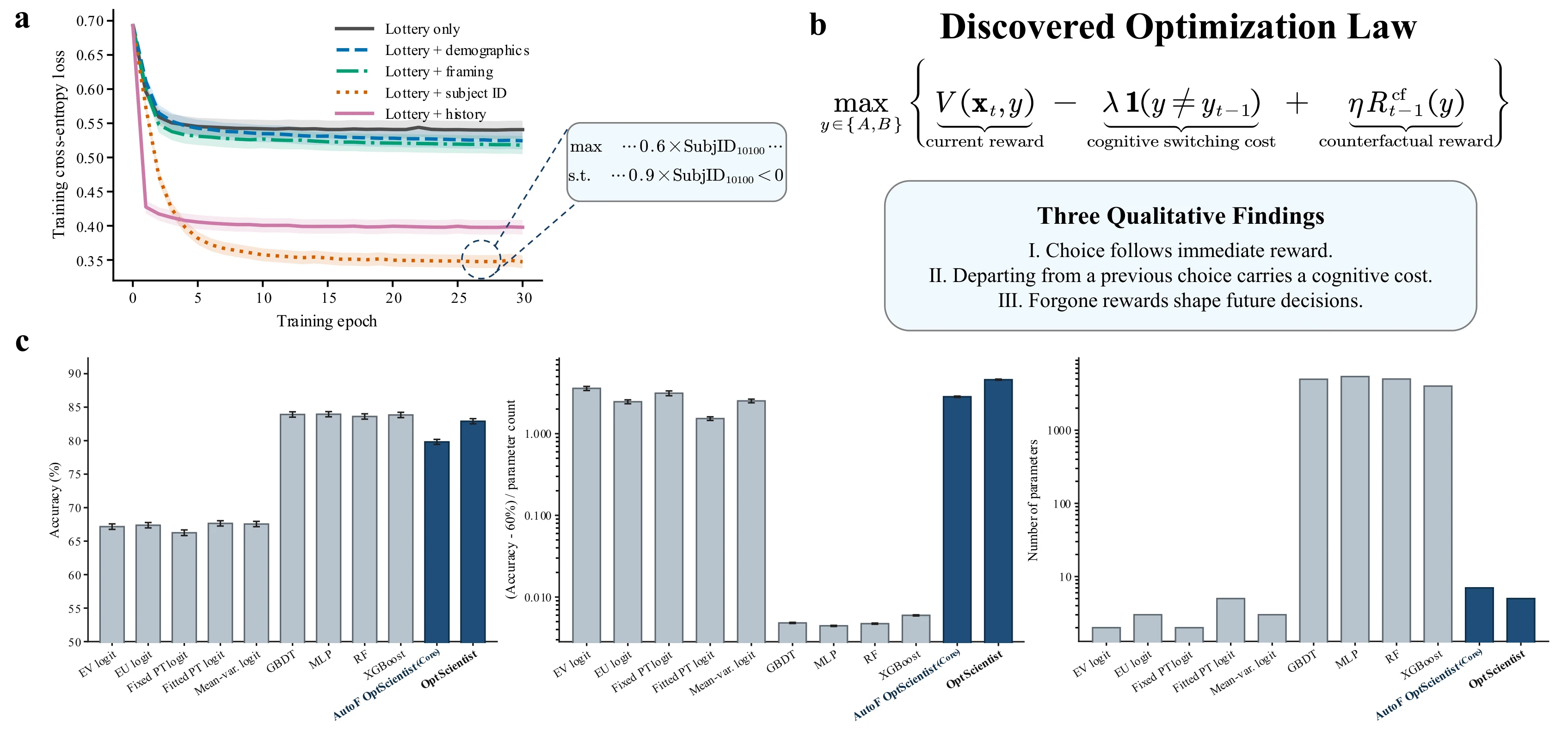
Applied to human risky choice, OptScientist discovers a compact law combining expected reward, cognitive switching cost, and counterfactual reward. These terms provide an interpretable optimization-based account of choice while maintaining competitive held-out predictive performance.
Figure 5.A discovered optimization law for human risky choice. Full results showing the symbolic law, its qualitative interpretation, and predictive comparisons. Select to enlarge ↗
03 MACROECONOMICS · Monetary policy
Central-bank monetary decisions
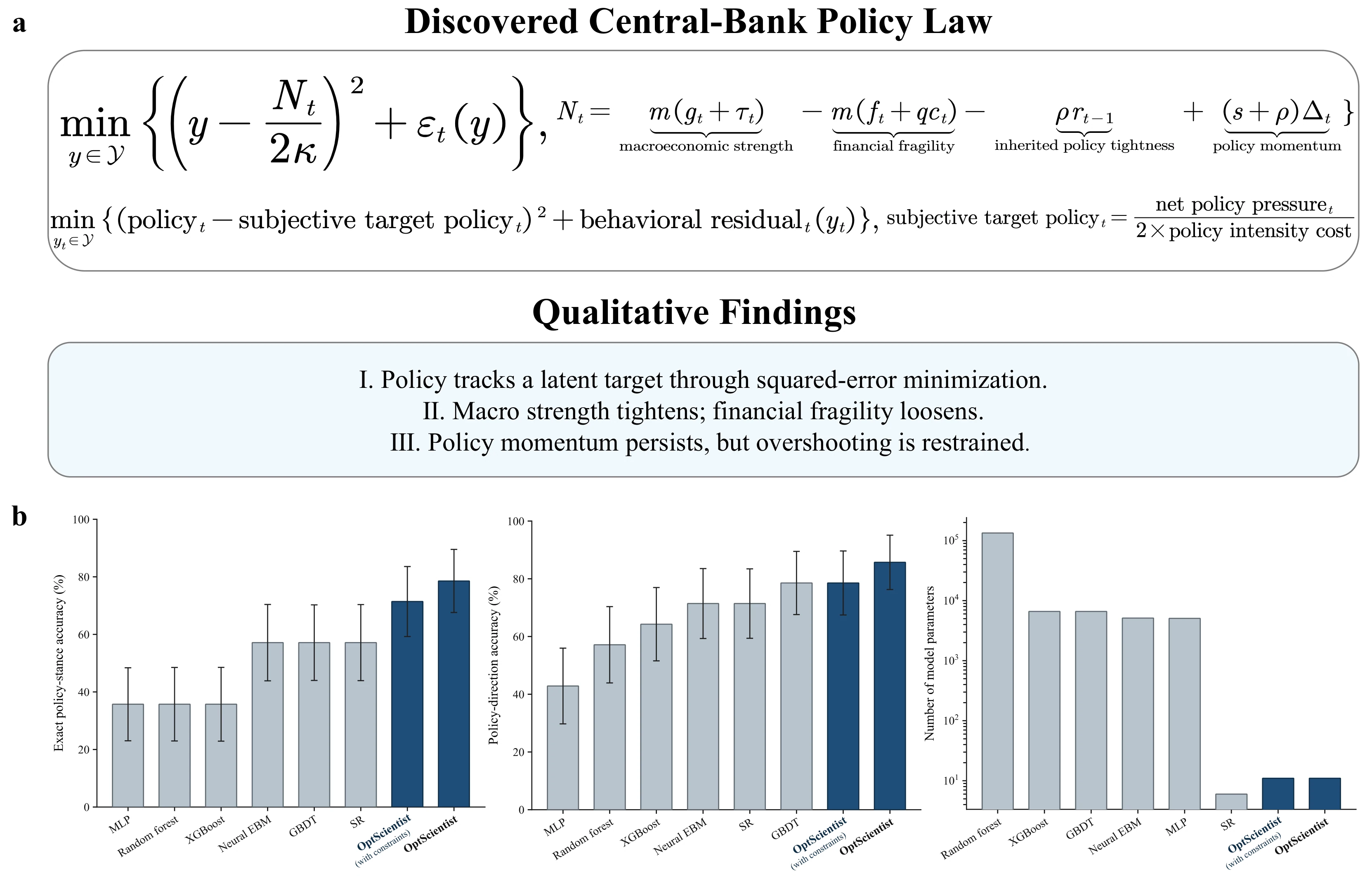
For monetary-policy decisions, OptScientist discovers a law in which observed policy tracks a latent subjective target through squared-error minimization. The resulting symbolic expression offers a compact candidate explanation for policy decisions and performs competitively against the evaluated baselines.
Figure 6.A discovered law for central-bank monetary policy. Full results including the latent target-tracking formulation, qualitative findings, and comparisons. Select to enlarge ↗
04 DISCOVERY EFFICIENCY · Compact symbolic laws
Interpretable structures, economical discovery
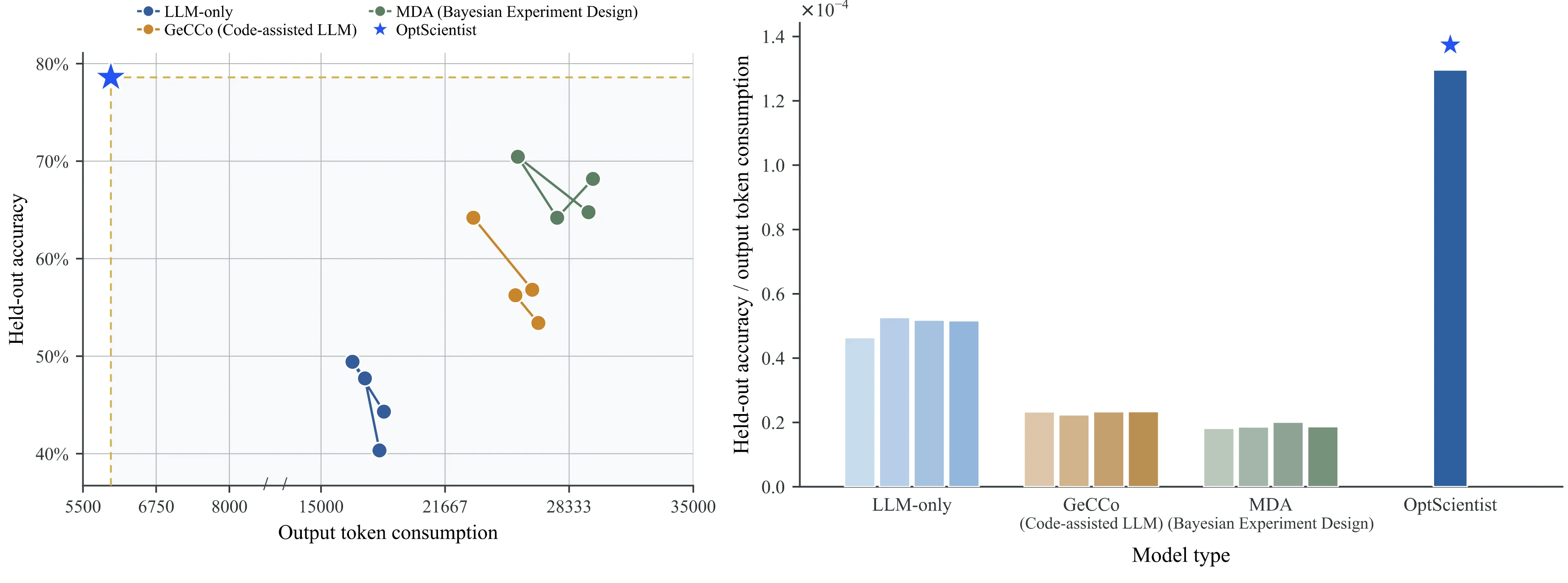
Across the two real-world studies, the discovered laws attain competitive held-out performance with near-minimal parameter counts and symbolic complexity, while requiring substantially fewer output tokens than LLM-based discovery approaches.
Figure 7.Predictive performance and discovery efficiency. Comparison with LLM-only, code-assisted, and experiment-design baselines.
Scientific perspective
Optimization Laws Across Sciences
Across science, theories frequently explain phenomena as the solutions of optimization problems. The interpretation of each objective and constraint depends on the discipline, but the methodological question is shared: can the law that generates an observed outcome be learned from data?
Physical sciences
Energy and free-energy minimization provide mathematical descriptions of equilibrium states. OptFeynman offers a controlled demonstration of recovering physics-derived optimization laws from observations.
Biological sciences
Fitness-related optimality models describe how evolutionary outcomes may emerge from optimization. Such models motivate an additional domain for optimization-law discovery.
Behavior and cognition
Rational and resource-rational theories explain decisions through goals and constraints. The risky-choice study discovers a symbolic law that combines reward, switching costs, and counterfactual reward.
Social and economic systems
Economic models often begin with specified objectives and constraints. The monetary-policy study demonstrates how a candidate policy objective can instead be recovered from observed decisions.
From estimating parameters to discovering laws
Inverse optimization and revealed-preference approaches often start from a pre-specified optimization structure. OptScientist advances a complementary direction: learning the representation of an optimization problem, recovering its compact symbolic form, and incorporating the result into a research process of scientific priors, evaluation, abstraction, and further investigation.
A general method for scientific discovery
From observational patterns to optimization representations, from representations to symbolic laws, and from candidate laws to scientific theories through iterative evaluation.
Paper and citation
Read the full OptScientist paper (PDF) for mathematical details, the experimental protocols, recovered symbolic expressions, comparisons, and limitations.
OptScientist · arXiv · 2026
@misc{zhenyao2026optscientistautomateddiscoveryoptimization,
  title={OptScientist: Automated Discovery of Optimization Laws},
  author={Ma ZhenYao and Yue Liang and Jian-Qiao Zhu},
  year={2026},
  eprint={2610.28562},
  archivePrefix={arXiv},
  primaryClass={cs.AI},
  url={https://arxiv.org/abs/2610.28562},
}